Advancing Next-Generation Optical Interconnects: CPO, OCS, and Heterogeneous Integration
HSINCHU, Aug 24, 2026 —
With the rapidly growing demand for data transmission driven by AI, high-bandwidth and low-power optical interconnect technologies are becoming increasingly critical to semiconductor system architectures. As the industry moves from modular designs toward co-packaged optics (CPO), challenges such as thermo-mechanical stress and material compatibility are becoming increasingly important. This calls for integrated design platforms and models that can address packaging, materials, and multi-physics interactions.
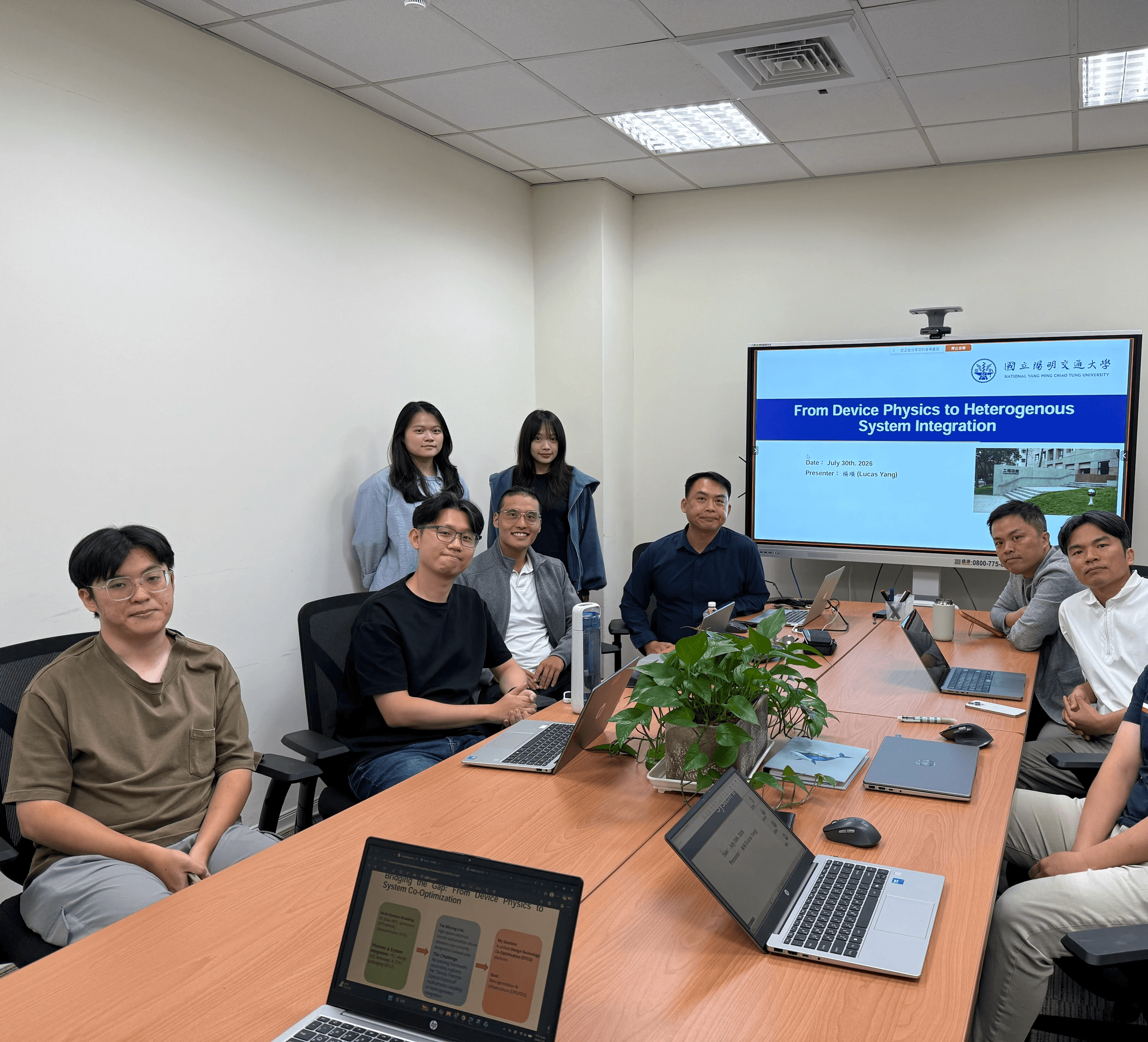
We are honored to welcome Dr. Shuen Yang (Lucas Yang) to RVi for a technical sharing session. Dr. Yang received his Ph.D. from the Graduate Institute of Photonics and Optoelectronics at National Taiwan University and was previously a postdoc researcher at the University of California, Berkeley (UC Berkeley). He is currently an adjunct assistant professor at the department of microelectronics of National Yang Ming Chiao Tung University (NYCU). His expertise spans the development of multi-physics models and design platforms for heterogeneous integration, high-speed analog and mixed-signal circuit design, and VCSEL-based co-packaged optical systems.
During the session, Dr. Yang shared his research on Optical Circuit Switching (OCS) at UC Berkeley. Through flip-chip bonding and bump flattening, his work enables the heterogeneous integration of back-emitting VCSELs. By using directional couplers to switch between drop-state and through-state, the optical path of the waveguide can be controlled. This technology has the potential to be integrated with VCSELs to realize dynamically configurable optical routing systems.
In addition, Dr. Yang is currently focusing on the development of Design Technology Co-Optimization (DTCO) platforms, including the conversion of TCAD physical models into SPICE circuit simulations, as well as scalable packaging solutions for ultra-low-loss wafer-level OCS. These efforts aim to overcome existing platform and technological limitations while addressing the integration challenges of CPO and OCS.
We sincerely thank Dr. Yang for sharing his insights and expertise. The RVi team will continue to explore and develop more efficient and reliable next-generation optical interconnect architecture!